
Pregnancy dream meaning: what it can mean to dream you’re pregnant
You run a hand over a round belly that was not there yesterday. Or you are in a delivery room, holding a newborn you somehow know is yours. Then you wake up, not pregnant, maybe not even planning to be. A pregnancy dream can feel like an announcement. It is more often an image of something growing in your life, or of a worry about it, and the details help you tell which.
Quick answer
Dreaming that you are pregnant does not mean you are, and it does not predict a pregnancy. Outside pregnancy, the image often goes with something that is starting or growing: a project, a new role, a relationship, a change you are preparing for, or the question of having children. During pregnancy, vivid dreams and nightmares are common, partly because sleep is more broken. Your emotion in the dream is the best clue to which reading fits.
Why dream of pregnancy when you’re not pregnant?
A dream rarely announces a real event. It borrows images from what is already on your mind. Dream researchers such as G. William Domhoff describe this as a continuity between dreams and waking life: the people, plans and worries that fill your days tend to come back at night, often exaggerated or in disguise.
Pregnancy is an obvious image for that. Something grows out of sight, takes time, changes your body and your routine, then arrives whether you feel ready or not. It can stand for many things besides a baby. The dream often shows up when you are:
- Starting something: a job, a course, a business, a move
- Working on a project you have not shown anyone yet, such as a book, an application or a plan
- Taking on a new responsibility, for a team, a parent or a home
- Thinking about having children, or about not having them
- Changing in yourself, in a way that is not finished yet
These are leads, not rules. The same dream can feel joyful to one person and frightening to another, and it will not mean the same thing for both.
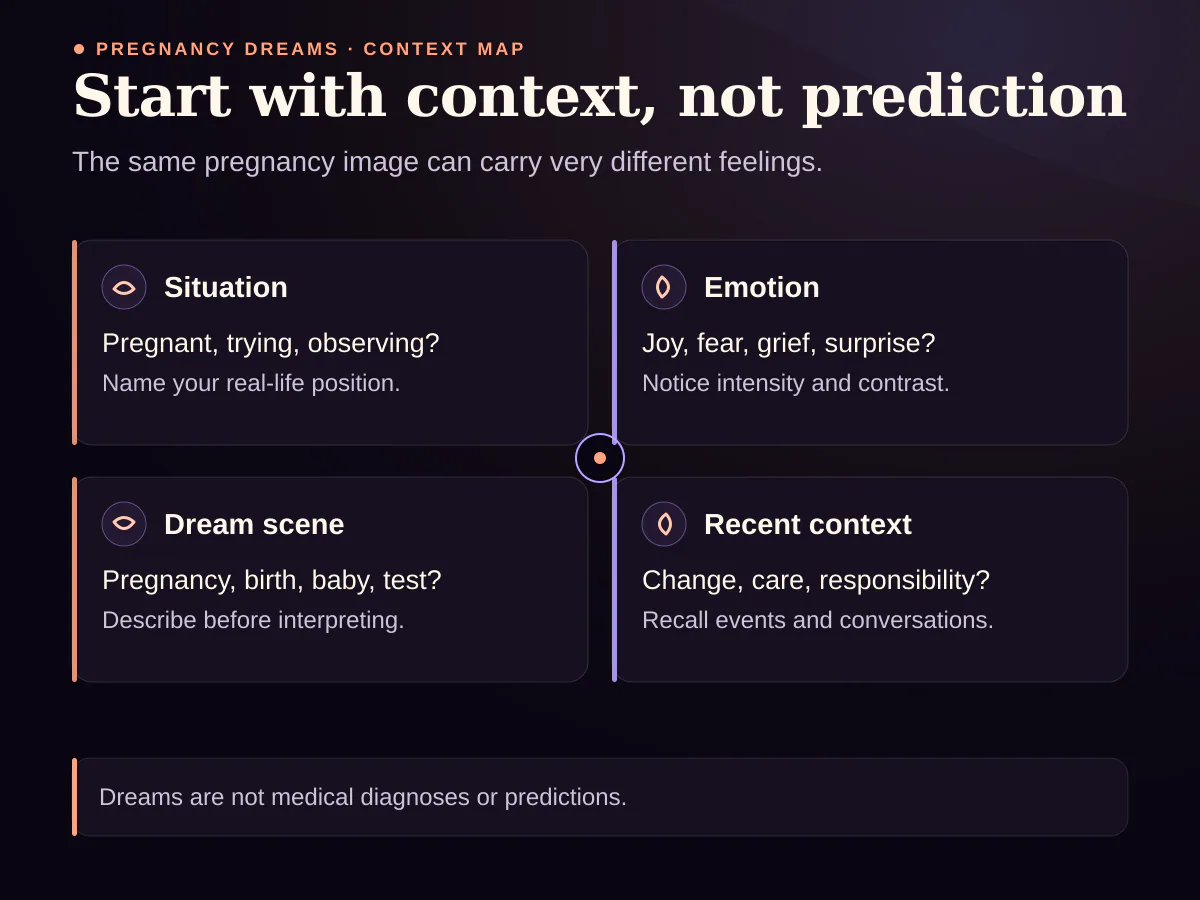
What happened in your dream?
Before looking for meaning, describe the scene. These variations are not definitions. They are questions to check against what you felt.
Finding out you’re pregnant
A positive test, a doctor’s announcement, a belly you suddenly notice? Discovery dreams can go with the moment you realize something new has started. Were you thrilled, shocked or worried? That first reaction says more than the news itself.
Being heavily pregnant
Heavy steps, a due date close by: the scene can echo something nearly ready, or a deadline that keeps getting closer. Did you feel ready, or did you want more time?
Giving birth
A birth brings something into the open. An easy delivery and a painful one do not tell the same story: the dream may mirror how you picture a coming change. Who was with you, and where were you?
Complications or miscarriage
These dreams are hard to wake up from. They often go with a fear of losing something fragile: a project, a relationship, a hope. After a real loss, they can also bring grief back. They predict nothing about a pregnancy.
An unplanned pregnancy
Pregnant without having planned it, sometimes in an impossible situation? The dream may echo a change you did not choose, or a responsibility that arrived before you felt ready. What in your life started without asking you?
Someone else pregnant
A friend, a sister or a colleague expecting? The dream may be about your relationship with that person, a change you see in them, or a side of yourself they remind you of. It is not a sign that they are pregnant.
Five ways to read a pregnancy dream
No list can tell you why you had this dream. These readings come up often when people compare the dream with what they are living through. Keep the one that rings true and leave the others.
1. Something you are working on
Pregnancy as incubation: a project that needs time before it can be shown. If the dream comes back while you write, build or prepare something, the link is worth noting. Which project are you carrying right now?
2. A change in yourself
Some people have this dream during a stretch of personal change: gaining confidence, leaving an old role, settling into a new one. What about you is not quite the same as a year ago?
3. A new start
A new job, a new relationship, a new city. The dream can go with the uncertainty of a beginning, when something has started but you do not know yet what it will become.
4. The weight of a responsibility
Like expecting a child, a new commitment asks for care and attention. If the dream felt heavy, ask yourself what you are afraid of not handling, and whether you have the support you need.
5. The question of children
Sometimes the simplest reading is the right one. If you are trying to conceive, hesitating, or have decided not to have children, the dream may simply replay a question that matters to you. It does not tell you what to decide, or what your body is doing.
A pregnancy-dream journal example
Fictional example: this entry shows how to keep the scene, the emotion and a possible link with your day apart.
- Dream: “I was eight months pregnant at my desk. My manager kept handing me files, and I was afraid the baby would come before I had finished.”
- Emotion: “Proud at first, then panicked. I woke up with my heart racing.”
- Recent context: “We launch a new service at work next month. I’m not pregnant and not planning to be.”
- Question to keep: “Does this dream come back as deadlines get closer, or in quiet weeks too?”
One entry proves nothing. If you note the same details over several nights, you will see whether the work lead holds up or something else is going on.
Who has pregnancy dreams?
Men, and people who cannot be pregnant
Nothing in a dream requires a body that can carry a child. Men can dream they are pregnant too, and so can people of any gender. The image works the same way: something you carry, something about to arrive.
People who do not want children
Dreaming you are pregnant does not mean you secretly want a baby. The dream may be about something else entirely, or echo the questions people keep asking you. Your reaction in the dream tells you more than the image.
People trying to conceive
When you are trying for a baby, these dreams can be tender or painful, especially after a negative test. They show how present the hope is. They are not a sign that it is happening, or that it will not: only a test can tell you whether you are pregnant.
After a pregnancy loss
After a miscarriage or a difficult birth, pregnancy dreams can come back for a while. They can be part of grieving. If they keep you from sleeping or leave you in distress, talking to your doctor, midwife or a therapist can help.
Dreams during pregnancy: what research shows
If you are pregnant, vivid dreams and nightmares are common, according to the Sleep Foundation. Sleep is more broken, and waking up in the middle of a dream makes it easier to remember.
Babies, birth and becoming a mother
In a study by Lara-Carrasco and colleagues (2013), women in their third trimester kept a dream diary for two weeks. Compared with women who were not pregnant, they dreamed more often of babies, of themselves as mothers, and of pregnancy and childbirth. Their dreams also held more unsettling images. The authors link this to the way pregnant women reshape their sense of themselves as mothers and their image of the baby.
More bad dreams in the third trimester
A second study by the same team (2014) found that pregnant women in their third trimester recalled more bad dreams and nightmares than women who were not pregnant. Worry about the birth and more frequent night waking are likely part of the picture. A frightening dream about the baby is not a warning about the baby.
After the birth
Tore Nielsen and Tyna Paquette (2007) compared pregnant women, new mothers and women who had never been pregnant. Dreams about the baby were frequent in both of the first two groups. New mothers more often dreamed that the baby was in danger, and more often moved during these dreams. Many woke up anxious or confused, with an urge to check on the baby. Knowing that this is common can make those nights less alarming.
When to talk to someone
Tell your midwife, doctor or a therapist if nightmares keep you from sleeping, if the same nightmare keeps coming back, or if you feel anxious or low during the day. These signs deserve attention during pregnancy and after the birth, and help exists. Our guide to nightmares describes approaches that can help.
What to do after a pregnancy dream
1. Write down the scene, then the emotion
Who was pregnant, how far along, where were you, how did it end? Then one line on how you felt. The emotion often links the dream to your day more clearly than the image does.
2. Ask what is growing in your life
What am I working on, waiting for or worried about? If an answer comes quickly, note it next to the dream. If nothing fits, leave the question open for a few nights.
3. Read the stage as a question, not a timeline
An early pregnancy or a birth does not set a deadline in your life. It can prompt a question: does this project feel like it is just starting, or long overdue?
4. Look at the baby, if there was one
Was the baby calm, crying, strange, left somewhere? Those details can mirror how you feel about what you are bringing into the world, or simply your thoughts about a real child.
5. Keep the dream apart from reality
A dream is not a pregnancy test. If you think you might be pregnant, a test or your doctor will tell you. If you are pregnant and a dream worries you, bring it up at your next appointment rather than looking for omens.
Explore Related Symbols
Read up on the symbols mentioned in this article:
Frequently asked questions
What does it mean to dream about being pregnant?
There is no single meaning. The dream often goes with something new or growing in your life: a project, a role, a relationship, a change, or the question of having children. Your emotion in the dream and what you are going through right now are the best clues.
Why do I dream about pregnancy when I’m not pregnant?
Dreams borrow images from what is on your mind. Pregnancy is a natural image for something that takes time to grow and changes your life. A new job, a project or a decision about children can all bring it back, whatever your gender.
Do pregnancy dreams predict actual pregnancy?
No. A dream cannot detect a pregnancy or announce one. If you think you might be pregnant, take a test or see a doctor.
Is it normal to have nightmares during pregnancy?
Yes, bad dreams and nightmares are common during pregnancy, especially in the third trimester, and they do not predict anything about the baby. If they disrupt your sleep, keep coming back or leave you anxious during the day, mention them to your midwife or doctor.
Read next
More resources on the same topic
Recurring Dreams Meaning: Understanding Their Messages
Why the same dream keeps coming back, what to note between episodes, and when repeated nightmares are worth a doctor's visit.
InterpretationTeeth Falling Out Dreams: Meaning and Interpretation
Seven possible readings of dreams about teeth falling out, from jaw tension to fear of being judged, and the variations worth noting.
InterpretationFalling Dreams Meaning: Why You Dream of Falling
Why falling dreams happen, from the hypnic jerk at sleep onset to long falls, and what to note when you wake.
Sources and further reading
- Lara-Carrasco et al. (2013), “Maternal representations in the dreams of pregnant women: a prospective comparative study”, Frontiers in Psychology (PubMed)
- Lara-Carrasco et al. (2014), “Disturbed dreaming during the third trimester of pregnancy” (PubMed)
- Nielsen and Paquette (2007), “Dream-associated behaviors affecting pregnant and postpartum women”, Sleep, 30(9)
- Sleep Foundation, “How Pregnancy Affects Dreams”
- DreamResearch.net, G. William Domhoff
Updated October 9, 2026
Last updated: