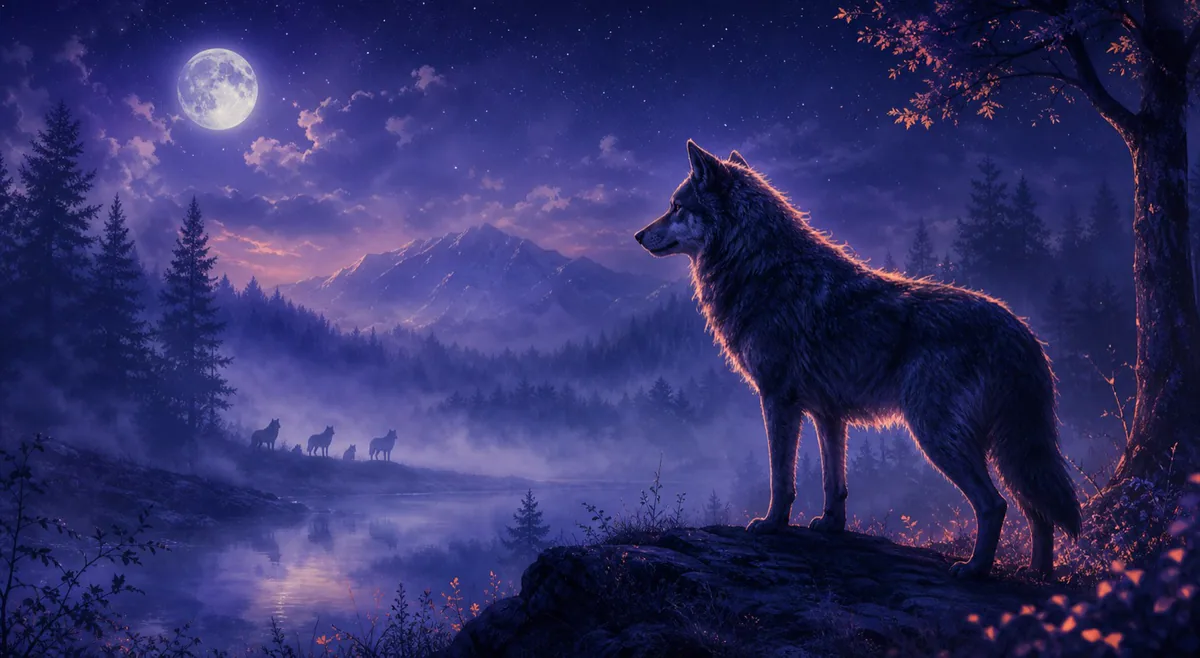
Dreaming of a wolf often stirs up instinct, threat or belonging. A wolf watching from the trees, one that attacks and a pack walking beside you are different scenes: the wolf's behavior and your fear or calm say more than a fixed meaning.
What Does It Mean?
Yellow eyes between the trees, a wolf that does not move, and you cannot tell whether it is waiting for you. Wolves are often associated with instinct, threat, protection or belonging. These are leads, not a verdict: the wolf's behavior and what you felt, fear, calm or curiosity, tell you which one to follow.

Common scenes
Choose the one closest to your dream.
Your scene: A lone wolf watching you
A wolf that keeps its distance can go with vigilance, curiosity or a worry that will not leave you. If you felt no fear, it can also match a quiet attention to something you do not yet understand.
Read the variation “A lone wolf watching you”Your scene: A pack of wolves
Were you part of the pack, surrounded by it, or watching it pass?
The scene often points to a group: belonging and loyalty on one side, rules and pressure on the other.
Read the variation “A pack of wolves”Your scene: Being chased by a wolf
A wolf on your heels often goes with something you are trying to avoid. Where were you running to, and did anyone help you? Whether you got away matters as much as the wolf itself.
Read the variation “Being chased by a wolf”Questions to Ask Yourself
- Was it one wolf, several wolves or a whole pack?
- Was the wolf watching, following, protecting or attacking?
- Where do I feel on my guard right now, or drawn to a group?
Detailed reading
Threat or protection? A wolf that attacks or chases you can echo a pressure or a conflict you are facing right now, without predicting any real danger. A wolf that walks beside you or guards you can go with a sense of support, or with trust in your own judgment. A wolf that only watches sits in between: something you are keeping an eye on. If the scene was mostly a chase, the being chased page goes further; if the setting mattered, see forest.
Alone or in a pack? A lone wolf turns attention to distance: independence you chose, or isolation you did not. A pack turns it to the group, family, team or friends, with its loyalty and its rules. Did the pack take you in, surround you or ignore you? The answer often points to a specific group in your life.
Fictional journal example: “I was walking home through a park at night and a wolf fell into step beside me. It never touched me. When I reached my door, it sat down and watched me go in.” Scene: a wolf escorting rather than hunting. Emotion: wary at first, then calm. Possible context: the first weeks of living alone after a move. Question: “What helps me feel safe now that no one is waiting at home?” Keep dreams like this in your dream journal to see whether the wolf comes back, and how its behavior changes.
Method: this page offers questions and possible associations, not a universal meaning or a prediction. It follows Noctalia's content methodology and is edited by Thanh Chau, publication director of Noctalia.
Common Variations
A wolf attacking
Did it bite, lunge or only threaten? An attack can echo fear, conflict or a pressure that feels too close. It does not predict real aggression. Note where you were and whether you fought back, ran or froze.
Being chased by a wolf
A wolf on your heels often goes with something you are trying to avoid. Where were you running to, and did anyone help you? Whether you got away matters as much as the wolf itself.
A lone wolf watching you
A wolf that keeps its distance can go with vigilance, curiosity or a worry that will not leave you. If you felt no fear, it can also match a quiet attention to something you do not yet understand.
A pack of wolves
Were you part of the pack, surrounded by it, or watching it pass? The scene often points to a group: belonging and loyalty on one side, rules and pressure on the other.
A friendly or protective wolf
A wolf that guards you or lets you come close can go with support, trust or a need for protection. Who or what was it protecting, and did you accept having it near?
A howling wolf
A howl in the night can sound like a call, or like loneliness. Was it far away or close, one voice or many? Note what you felt hearing it: longing, fear or a strange calm.
FAQ
What does it mean to dream about wolves?
Wolves are often associated with instinct, threat, protection or belonging to a group. The meaning shifts with their behavior, whether they watch, follow, protect or attack, and with how you felt: afraid, calm or curious.
What does a lone wolf mean in a dream?
A lone wolf can go with independence, distance or loneliness. Calm suggests a distance you chose; unease, a feeling of being cut off. Note whether the wolf came closer or kept its distance.
What does it mean to dream of wolves attacking?
Attacking wolves can echo fear, conflict or several pressures arriving at once. The dream does not predict a real attack or point to a hidden enemy. Compare it with a recent situation where you felt cornered.
What does a pack of wolves mean in a dream?
A pack often points to a group: loyalty, support, rules or social pressure. Feeling protected by it leans toward belonging; feeling surrounded, toward tension. The number of wolves alone does not set the meaning.