
The history of dream interpretation: from ancient temples to modern science
You wake up with an image you can't shake, teeth crumbling or a snake on the stairs, and you look up what it means. That reflex is old: people have been writing dreams down and trying to read them for more than 4,000 years. Here is how dream interpretation changed, from clay cylinders to sleep labs, and what each era can still teach you.
Quick answer
Written dream interpretation goes back more than 4,000 years, to Mesopotamia and Egypt, where dreams were read as divine messages or omens. Aristotle looked for natural causes, Freud and Jung made dreams psychological material, and since 1953 sleep labs have measured dreaming. These approaches overlapped, and none produced a universal code for symbols.
Dream interpretation timeline at a glance
2120–2110 BCE: Gudea's dream
A Sumerian ruler's cylinder: a god asks him, in a dream, to build a temple.
Around 1220 BCE: an Egyptian dream book
Papyrus Chester Beatty III lists dreams, each with a verdict: good or bad.
4th century BCE to 2nd century CE: Greek explanations
Aristotle seeks natural causes; Artemidorus writes a manual.
1900 to today: psychology and the lab
Freud and Jung build theories; from 1953, labs record sleep and dream reports.
Mesopotamia: the first written dreams
The Louvre dates Cylinder A of Gudea to 2120–2110 BCE. Its Sumerian inscription tells how the god Ningirsu appeared to Gudea, ruler of Lagash, in a dream and asked him to build a temple. The dream is not a private puzzle here: it gives a royal project divine backing.
Later, scholars compiled lists of dream omens. A compendium from the archive of the Assyrian king Ashurbanipal (7th century BCE) often works through wordplay, as Scott Noegel's study shows: eating a raven (arbu) meant income (irbu), because the words sound alike. The reading depended on language, not on how the dream felt. And none of this tells us who first interpreted a dream.
Egypt: a manual of good and bad dreams
Papyrus Chester Beatty III, dated by the British Museum to around 1220 BCE, contains a dream book in hieratic script. Each entry gives a dream, a verdict, good or bad, then a meaning. Eating donkey meat was good: the dreamer would rise in rank. Teeth falling out, still a common dream today, was bad: one of the dreamer's dependants would die.
Many of these links rest on puns that only work in Egyptian. The manual shows how a society reasoned about the night; it does not validate its predictions.
Greece: healing temples, a philosopher and a manual
In sanctuaries of Asclepius such as Epidaurus, sick people slept in the temple hoping the god would heal them in a dream. This is called incubation; some people now try a secular version by asking a question before sleep.
Aristotle takes another route. In On Dreams, dreams arise from traces of sensory impressions that persist once their object is gone. In On Prophesying by Dreams, he notes that physicians watch dreams as possible signs of the body's state, but judges most “prophetic” dreams to be coincidences.
In the 2nd century CE, Artemidorus wrote the Oneirocritica, a manual in five books. He insists that the interpreter know the dreamer: occupation, health, age, habits. The same image does not mean the same thing for everyone, an idea that has aged better than his predictions.
What do sacred texts say about dreams?
In Genesis 41, Joseph reads Pharaoh's dreams of cattle and grain as seven years of plenty followed by seven of famine, an interpretation the text attributes to God. In Matthew's Gospel, another Joseph learns in a dream about Mary's pregnancy.
The Talmud discusses dreams at length in tractate Berakhot, where Rav Hisda compares an uninterpreted dream to an unread letter. In Islam, a hadith in Sahih al-Bukhari calls a believer's good dream one of the forty-six parts of prophecy, and dream manuals circulated under the name of Ibn Sirin (died 728), an attribution some scholars doubt. The Mandukya Upanishad treats dreaming as a state of consciousness between waking and deep sleep, and Tibetan Buddhism developed dream yoga, close to lucid dreaming.
These passages say what their texts say. They are neither evidence that dreams predict the future nor a summary of what every believer thinks.
The Middle Ages: where do dreams come from?
In the Summa Theologiae (II–II, question 95, article 6), Thomas Aquinas asks whether divination by dreams is unlawful. His answer depends on the cause. Some dreams come from waking thoughts or the state of the body, and can be read as signs, as a physician reads symptoms. Within his theology, others may come from God or from demons; seeking knowledge from demons is what he condemns. Natural and religious explanations sit side by side in one argument.
Ancient texts
Omen lists, an Egyptian manual, Aristotle: dreams as messages, signs or natural events.
Medieval theology
Aquinas sorts dreams by cause, natural or supernatural.
Modern approaches
Psychoanalysis interprets; sleep research measures.
Freud: wishes and the unconscious
The Interpretation of Dreams appeared in November 1899, dated 1900. Freud argues that a dream is the disguised fulfilment of a wish, and presents dream interpretation as a privileged route to unconscious mental life.
- Manifest content: the dream as you remember and tell it.
- Latent thoughts: what Freud sought to reconstruct through analysis.
- Dream work: the transformations he proposed between the two, such as condensation and displacement.
His method relied on free association: the dreamer says what each element brings to mind. The theory remains debated and is not a decoding manual. One part still serves anyone keeping a journal: your own associations count for more than a dictionary entry.
Jung: dreams, myths and archetypes
Carl Jung broke with Freud around the time of Psychology of the Unconscious (1912), which compares dream and fantasy material with mythology. He went on to describe a collective unconscious, recurring figures he called archetypes (the shadow, the anima and animus, the self), and dreams that compensate for a one-sided conscious attitude. These are interpretive concepts, not research findings: similar images in different stories do not prove that a symbol means the same thing for everyone.
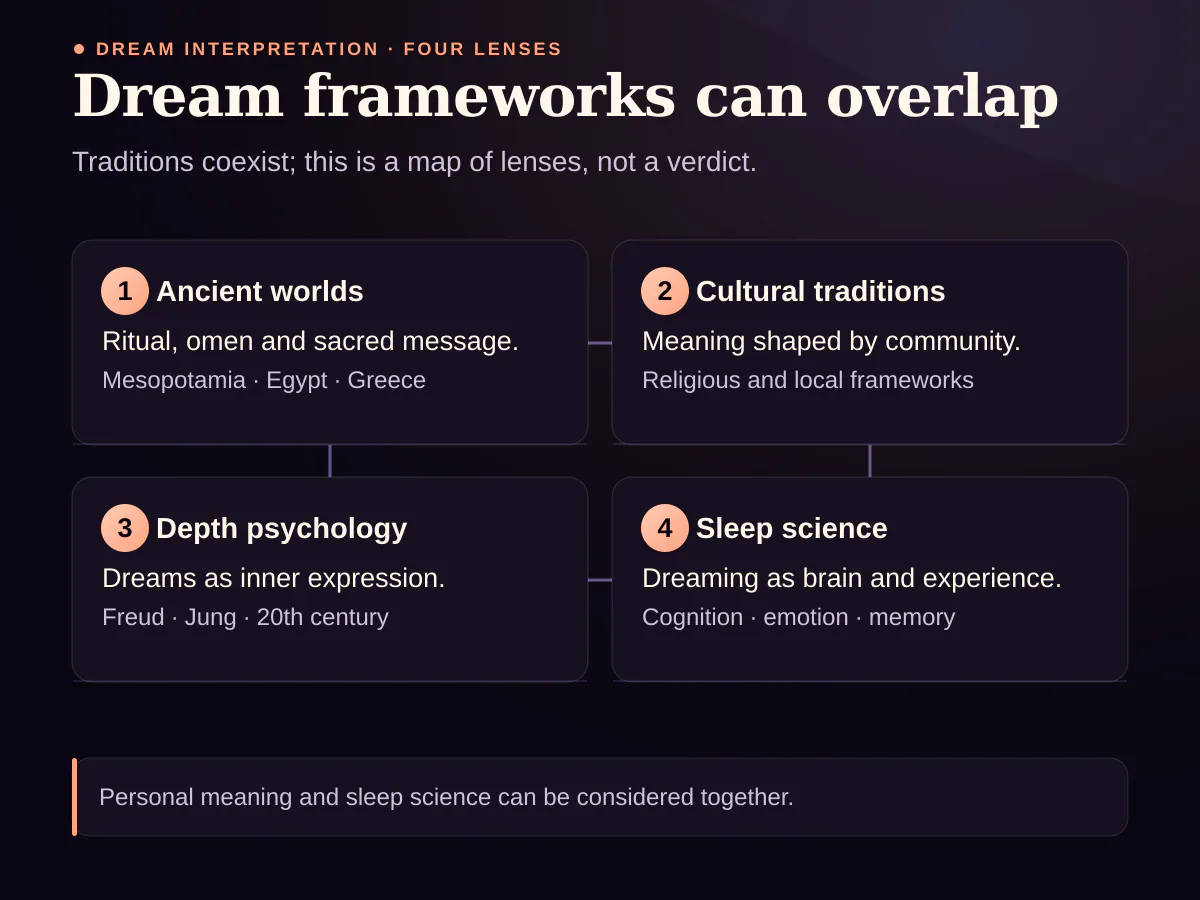
Modern science: what can be measured?
In 1953, Aserinsky and Kleitman described recurring periods of rapid eye movement during sleep, opening the lab study of REM sleep and dreams. Siclari and colleagues (2017) confirmed that people also report dreams after waking from non-REM sleep. Hobson and McCarley's activation-synthesis hypothesis (1977), which sees dreams as the brain making sense of activity generated in REM sleep, was influential and remains debated.
Dreams and waking life
In a 2003 diary study, 29 participants logged their dreams and days for two weeks. About two thirds of the 299 reports (65%) contained elements of recent waking life, but only 1–2% replayed an actual episode. One study, not a universal rule, but it matches what journal keepers notice: dreams borrow from your days and rearrange them.
Proposed functions are still hypotheses
Revonsuo's threat-simulation hypothesis suggests that dreaming rehearses threatening situations. It is a proposal, not an explanation of every nightmare.
Decoding and communicating with dreamers
A Japanese team used brain imaging to predict broad categories of images reported by three participants at sleep onset (2013). In a 2021 study of 36 participants, experimenters obtained 29 correct answers from six lucid dreamers during REM sleep. Limited demonstrations, not machines that read a dream.
How to read dream beliefs, and your own dreams
One account cannot speak for a whole people. In the 17th century, Jesuit missionaries described Haudenosaunee (Iroquois) communities where a dream could express a wish of the soul that others helped fulfil; Anthony Wallace analysed those outsiders' accounts in 1958. Translation misleads too: the English word “Dreaming”, used for Aboriginal Australian concepts, refers to ancestral law and creation, not mainly to nightly dreams.
A snake, water or fire can carry opposite meanings from one text to another. Before trusting an interpretation, ask who wrote it, when, and whether it describes a belief, a practice or a research finding.
Three lenses on one dream
Fictional example, to show how this history can help you look at a dream without deciding its meaning for you:
- Dream: “My teeth came loose one by one while I was talking in a meeting.”
- Emotion: “Embarrassment more than pain. I tried to hide my mouth.”
- Recent context: “A job interview on Thursday.”
- Question to keep: “Does this dream come back before other moments when I am judged?”
An Egyptian scribe would have seen a bad omen, Freud would have asked what teeth bring to mind, a researcher would note the recent worry. Only you can check which thread fits. One entry proves nothing; noting the same details over several nights is what makes patterns visible.
Explore Related Symbols
Explore individual symbol guides, or browse the dream symbols dictionary.
Frequently asked questions
Who first interpreted dreams?
Nobody can say. One of the oldest surviving examples is Cylinder A of Gudea, dated by the Louvre to 2120–2110 BCE, which tells of a dream about building a temple. It documents a practice, not its beginning.
Did Freud invent dream interpretation?
No. Aristotle and Artemidorus wrote about dreams more than 1,500 years before him. Freud proposed a psychological theory, published in 1899, built on the dreamer's own associations.
How do different cultures interpret dreams differently?
Dreams have been read as divine messages, omens, bodily signs or wishes of the soul. But one text never represents a whole community: ask who recorded an interpretation, when, and in what context.
What does modern science say about dream meaning?
Sleep labs measure brain activity and collect dream reports. Dreams often borrow from recent waking life, but research has found no universal code for symbols. Meaning remains a personal reading.
Sources and further reading
- Louvre, Cylinder A of Gudea
- Noegel (2006), “On Puns and Divination”
- British Museum, Papyrus Chester Beatty III
- Britannica, “Asclepius”
- Aristotle, On Dreams
- Aristotle, On Prophesying by Dreams
- Wikipedia, “Oneirocritica”
- Genesis 41 and Matthew 1:18–2:12
- Talmud, Berakhot 55a
- Sahih al-Bukhari 6987 and Wikipedia, “Ibn Sirin”
- Wikipedia, “Mandukya Upanishad”
- Aquinas, Summa Theologiae, II–II, q. 95, a. 6
- Freud, The Interpretation of Dreams
- Jung, Psychology of the Unconscious
- Aserinsky and Kleitman (1953), Science
- Siclari et al. (2017), Nature Neuroscience
- Hobson and McCarley (1977), American Journal of Psychiatry
- Fosse et al. (2003), Journal of Cognitive Neuroscience
- Revonsuo (2000), Behavioral and Brain Sciences
- Horikawa et al. (2013), Science
- Konkoly et al. (2021), Current Biology
- Wallace (1958), American Anthropologist (record)
- The Conversation, “Dreamtime and the Dreaming”
Read next
More resources on the same topic
Why Do We Forget Our Dreams? The Science Behind Dream Amnesia
Why dreams fade within minutes of waking, what REM sleep and memory have to do with it, and simple habits to keep more of them.
ScienceCan Dreams Predict the Future? The Science of Precognitive Dreams
What controlled studies say about dreams that seem to predict the future, and how coincidence and memory bias explain many cases.
ScienceDreams and Mental Health: How Your Sleep Reveals Your Mind
How anxiety, depression, stress and trauma show up in dreams, and when frequent nightmares are worth raising with a professional.
Last updated: